Your app may have connected to another device in the area. Force quit the app, move your mobile device closer to your device, make sure no other Solius devices are nearby, and try connecting again.
FAQ
My app says it is connected to the device, but the device lights didn’t turn blue. What do I do?
More Questions
Is Solius safe?
Solius delivers more UVB light benefit than natural sun with significantly less risk by delivering UVB light in a highly controlled, consistent, and measured way. While all UVB light exposure carries some risk, Solius minimizes risk by using a precise wavelength and a built-in skin sensor that personalizes every session.
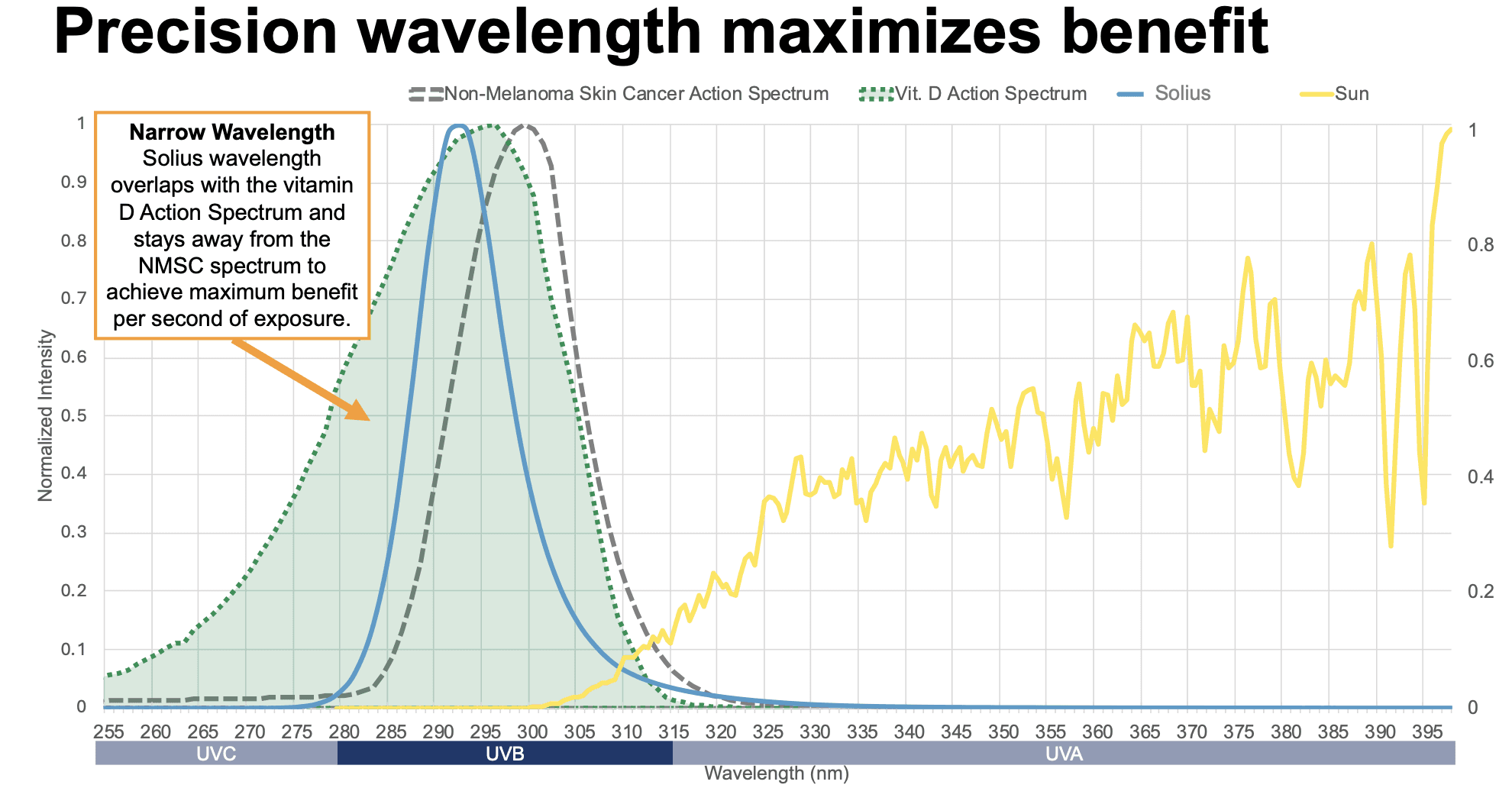
In natural sunlight, only a small portion of UV radiation actually contributes to vitamin D production. The rest includes UVA wavelengths that increase the risk of skin damage and skin cancer. Solius isolates the precise UVB wavelengths responsible for vitamin D synthesis and eliminates nearly all unnecessary UV radiation.
Because of this targeted approach, Solius can deliver the same vitamin D–effective dose as peak natural sunlight in a fraction of the time. Solius sessions last approximately 5 minutes and deliver an equivalent vitamin D dose compared to more than 60 minutes of natural sun exposure on a sunny afternoon at midlatitude (ASTM G173 AM 1.5 or a UVI of 9-11+) - making Solius 12x more efficient at stimulating vitamin D per minute of exposure in optimal conditions.
This efficiency keeps total UV light exposure extremely low. To put it into perspective, a full year of weekly Solius sessions delivers approximately the same total UV radiation as about five minutes of natural sunlight, or less than one second of sun exposure per day because 95% of UV radiation from the sun is UVA which has fewer benefits and more risk. When measured across the full UV light spectrum, Solius delivers approximately 0.4% of the total UV radiation of natural sunlight - meaning less than 1% of the UV light exposure associated with skin damage risk. This significantly reduces the likelihood of burning, tanning, premature aging, or UV light-related skin damage.
How does UVB light impact health besides through vitamin D production?
Several large population studies, such as Avoidance of sun exposure as a risk factor for major causes of death and Higher ultraviolet light exposure is associated with lower mortality, have shown that greater exposure to sunlight is linked to lower mortality and longer life expectancy. Although this has often been attributed to vitamin D, supplementation studies have not consistently shown the same benefits, suggesting that vitamin D explains only part of the effect.
The resulting publication from a 2024 expert review, Beneficial health effects of ultraviolet radiation: expert review and conference report, brought together clinical and biological research to show that UVB exposure influences multiple systems in the body - including cardiovascular, immune, metabolic, and neuroendocrine pathways - through mechanisms that extend beyond vitamin D.
Mechanistic studies help explain how this works. Photo-neuro-immuno-endocrinology: How the ultraviolet radiation regulates the body, brain, and immune system describes how UVB exposure activates a broad range of hormones, neurohormones, neurotransmitters, and immune mediators - including serotonin, dopamine-related peptides, and anti-inflammatory compounds. These signals can affect mood, stress regulation, energy balance, and immune function.
Similarly, How UV Light Touches the Brain and Endocrine System Through Skin, and Why shows that UVB can initiate communication between the skin and the brain through vitamin D-independent pathways. This includes the production of signaling molecules such as beta-endorphin and other peptides that influence stress responses, behavior, and hormonal activity.
Research from the University of British Columbia demonstrates that UVB also impacts the gut. Their study The gut-skin axis: a bi-directional, microbiota-driven relationship with therapeutic potential shows that UVB can alter gut-related immune and metabolic processes, partly through interactions with the microbiome, helping regulate inflammation and barrier function.
In addition, Impact of ultraviolet radiation on cardiovascular and metabolic disorders: The role of nitric oxide and vitamin D highlights that UV exposure can increase nitric oxide levels in the body, which helps relax blood vessels, improve circulation, and potentially reduce cardiovascular risk - again, independently of vitamin D.
Overall, this body of research indicates that UVB exposure acts as a broad regulator of human physiology, influencing multiple interconnected systems beyond its role in vitamin D production.
How is Solius different from the sun?
The sun provides both helpful and harmful UV light. While natural sunlight triggers vitamin D production, it also includes UVA light that can damage skin and increase long-term health risks. Solius isolates only the precise UVB wavelengths proven to stimulate vitamin D production, without the excess UV radiation that causes burning, aging, or DNA damage.
Solius provides the UVB light benefits of the sun with less than 1% of the total UV light risk. It is controlled, consistent, and personalized for your skin type using an advanced skin sensor to ensure each dose is right for you. Sunlight is difficult to dose, varies by season and weather, and includes wavelengths that can damage the skin.
How is Solius different from the SAD lamps, red light therapy, or tanning beds?
Solius’s novel and innovative technology uses a precise spectrum of light that delivers the benefits of UVB light exposure to the skin. It is a different technology from SAD lamps, red light therapy, and tanning beds. SAD lamps and red light devices use visible light - not UVB light - and therefore do not produce vitamin D nor activate UVB-linked biological responses.
Tanning beds emit mostly UVA wavelengths (often 95% or more) associated with aging and skin damage and tanning beds stimulate negligible amounts of vitamin D. Solius uses the precise UVB wavelengths that research shows activates hormone production, stimulates favorable metabolites, and fosters a diverse microbiome, without the harmful UVA ranges found in tanning beds or natural sunlight.
How is Solius different from vitamin D supplements?
Solius activates your body's natural vitamin D production through light, unlike pills that depend on digestion and can fail for those with malabsorption challenges. Rather than relying on the liver and kidneys to process supplements, the light process takes place directly in the skin, where vitamin D is meant to be produced. Because it follows the body's natural pathway, light-based vitamin D production is self-regulating and balanced, helping your body create exactly what it needs.
Vitamin D created naturally through light exposure lasts longer in the body and supports broader biological processes tied to mood, immunity, and metabolic balance. Beyond vitamin D, UVB light, like the Solius spectrum, also helps activate other light-related biological pathways that supplements cannot reach, supporting whole-body health, vitality, and overall well-being. It’s a more complete and naturally aligned way to help your health from the inside out.
Many sunlight-associated health benefits do not appear when people simply take supplements. This suggests vitamin D levels may not be the primary mechanism, but rather a biomarker for actual UVB light exposure – it is simply the most studied hormone that we know is produced by the sun. The skin synthesizes over a dozen compounds when exposed to sunlight, an entire process skipped by supplements. This is a relatively new area of science where new learnings shape our understanding of sunlight – and how we can benefit from it – every day.
How often do I need to use Solius to start experiencing its benefits?
In a clinical study, the average user saw a 10 ng/mL increase in vitamin D levels using Solius once a week over a 15-week period. This would move the average person in the USA and Europe from "insufficient" to "sufficient" levels of vitamin D.
Although Solius was designed for once-weekly sessions that last around five minutes (depending on your skin type), it is safe for everyday use – simple, efficient, and easy to fit into your routine.How does Solius differ from narrowband UVB phototherapy devices used to treat skin conditions?
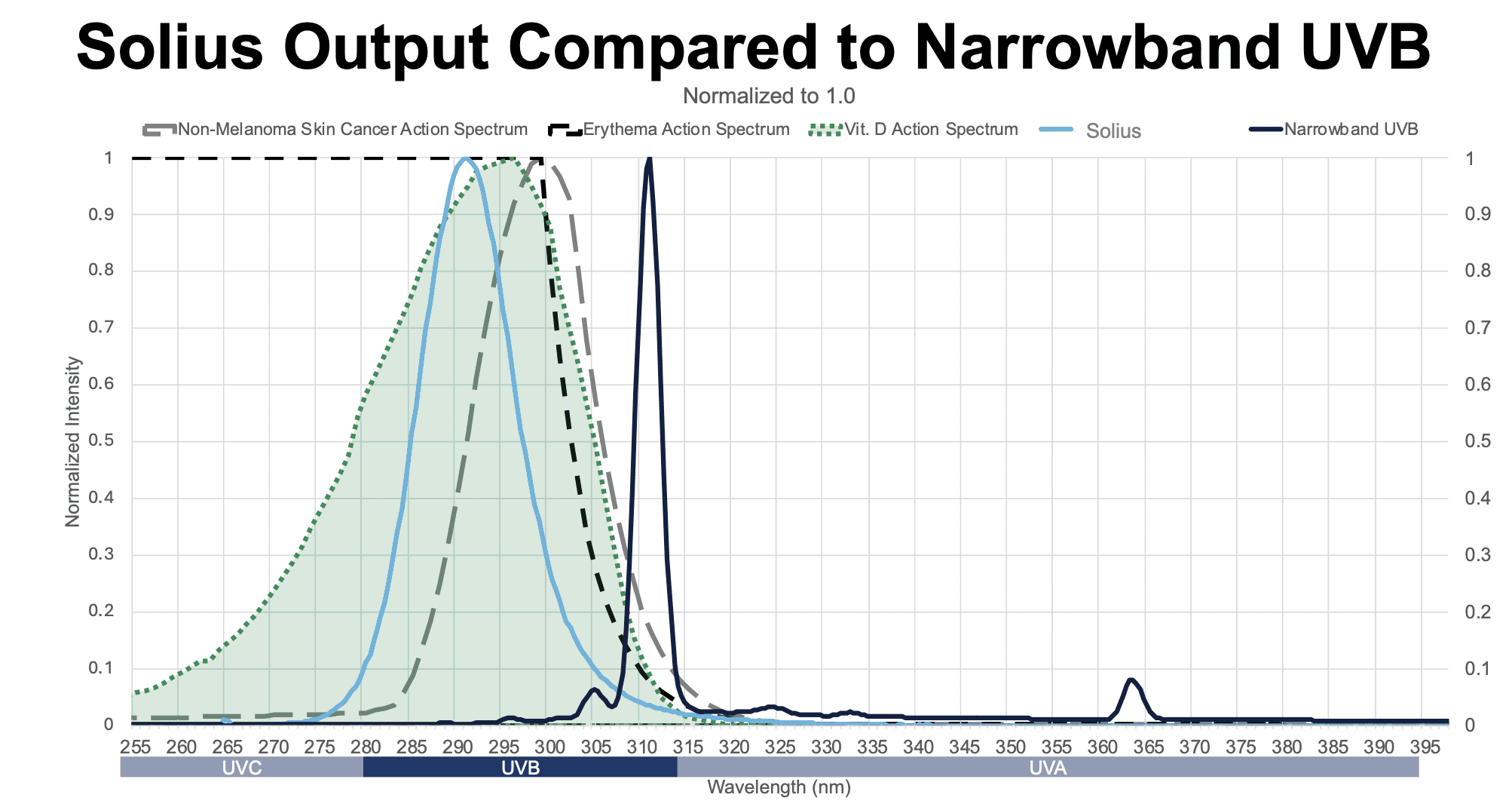
UV light has been used in medicine for over a century, including early dermatology treatments using phototherapy to treat skin conditions recognized with the 1903 Nobel Prize. While both Solius and traditional phototherapy devices use UVB light, they operate at different parts of the UVB spectrum.
Narrowband UVB phototherapy is primarily used to treat chronic skin conditions such as psoriasis, eczema, and vitiligo, leveraging UVB bulb technology developed in the 1980s that emits a peak wavelength at 311–313 nm. While referred to as “narrowband,” these bulbs still produce secondary emissions outside the intended range, including harmful UVA emissions.
These treatments expose localized areas of affected skin to UV light, working by suppressing local immune activity and slowing abnormal skin cell growth. They are typically administered under medical supervision, with dosing carefully managed by a trained clinician based on a patient’s condition and skin type. At-home devices at this wavelength are generally prescription-based and intended for specific dermatological use. The 311-113 nm wavelength is less powerful than the Solius wavelength but was previously the best available option to balance safety and efficacy.
Solius is designed to work beyond the skin to safely deliver the beneficial biological effects of sunlight, including vitamin D₃ production and other light-driven pathways linked to metabolic, hormonal, microbiome, and immune health to drive systemic benefits.
Decades of research show that the body produces vitamin D most efficiently in a specific portion of the UVB range, roughly between 290–315 nm, with peak effectiveness around 295–297 nm. Solius is tuned to ~293 nm, placing it close to this biological sweet spot and closer than traditional phototherapy devices. Within the UVB spectrum, even small changes in wavelength can significantly influence biological effects.
Solius is also positioned slightly below wavelengths more strongly associated with UV-induced DNA damage, which tend to peak closer to ~299–300 nm. This spectral positioning is designed to increase biological effectiveness while reducing overlap with higher-risk wavelengths.
Unlike traditional phototherapy systems, Solius incorporates an integrated safety and dosing system. This includes personalized dosing based on a patented and FDA-cleared skin sensor, automatic dose adjustments based on skin response, individual mobile app profiles for each user, therapy response feedback questions, distance sensing to ensure proper positioning, AI-assisted protective eyewear detection for eye safety, and enforced 24-hour lockout intervals between sessions to prevent overexposure.
Solius is the first FDA-cleared UVB device for over-the-counter use in this category, reflecting its focus on safe, consistent use outside of a clinical setting without a prescription.
Why does Solius target a 293 nm peak wavelength?
Solius delivers UVB energy at a precise wavelength targeting 293 nm, selected to optimize biological benefit while minimizing unnecessary risk.
Targeting the Most Effective Part of Sunlight
In natural sunlight, UVB represents less than 1% of total solar energy reaching the Earth’s surface, yet it drives some of the body’s most important biological processes, including vitamin D₃ synthesis.
Decades of photobiology research, including the CIE vitamin D action spectrum, show that vitamin D production in human skin is most efficient within the 290–315 nm range, with peak effectiveness around 295–297 nm.
Positioned for Efficiency with Reduced Risk
Solius is intentionally tuned slightly below this peak, centering around 293 nm. This positioning is designed to maximize the healthy benefits of UVB while reducing overlap with wavelengths more strongly associated with DNA damage. The CIE non-melanoma skin cancer (NMSC) action spectrum peaks closer to ~299–300 nm, where carcinogenic risk is higher. By shifting just below this region, Solius preserves strong biological activity while reducing exposure to higher-risk wavelengths.
Clinical and photobiology research consistently show that the narrow UVB band between ~291–295 nm provides an optimal balance of high efficiency for vitamin D₃ synthesis and lower relative contribution to erythema and DNA damage. Solius concentrates its output within this narrow therapeutic window, delivering a precise biological signal rather than the broad, inefficient spectrum of natural sunlight.
By engineering light at this specific wavelength range, Solius maximizes the beneficial effects of UVB while minimizing total UV exposure and avoiding unnecessary radiation - enabling a more controlled and efficient alternative to natural sun exposure.
How does Solius safely dose targeted sunlight benefits?
Solius delivers the health benefits of sunlight through two core innovations: a highly targeted UVB spectrum and a personalized dosing system designed to maximize benefit while minimizing risk.
Precise Spectrum
In natural sunlight, UVB makes up less than 1% of total solar radiation reaching the Earth’s surface, yet it is responsible for key biological effects such as vitamin D production. The majority of UV exposure is UVA, which contributes little to these benefits while driving much of the long-term skin damage associated with sun exposure.
Solius is engineered to concentrate its output almost entirely within the biologically active UVB range, with a targeted peak of 293 nm. By isolating the wavelengths most responsible for beneficial effects and eliminating nearly all unnecessary radiation, Solius delivers a highly efficient signal with dramatically reduced total UV exposure.
Personalized Dosing
Solius pairs this targeted spectrum with a personalized dosing system that adapts to your skin.
Before your first session, the Solius app collects information about your skin history, and the device measures your skin using an integrated sensor. Based on this data, Solius calculates a conservative starting dose, typically around 40% of your estimated maximum safe exposure.
This dosing approach is grounded in established dermatology principles and informed by skin response data from nearly 10,000 individuals across a wide range of skin types.
After each session, Solius continues to adjust based on your skin’s response. If you report prolonged redness or irritation, your dose is automatically reduced to prevent overexposure. If your skin tolerates the session well, you can gradually increase exposure in controlled increments, following clinically established guidelines.
By combining a precise UVB spectrum with adaptive, feedback-driven dosing, Solius delivers the benefits of sunlight in a controlled, measurable, and significantly lower-risk way than natural sun exposure.
Why is “Increase” not available on the Adjust personalized dose screen?
The “Increase” dose option may not be available for a few reasons:
Dose adjustments are not enabled until you complete your first therapy.
If you have already increased your dose, you must complete one full therapy at that level before increasing it again.
If you have reported skin pinkness, redness, or irritation, you have reached your maximum recommended dose. For your safety, the app will not allow further increases beyond this level.
If your skin has fully recovered and you would like to increase your dose duration, you may reset your skin measurement in the app.