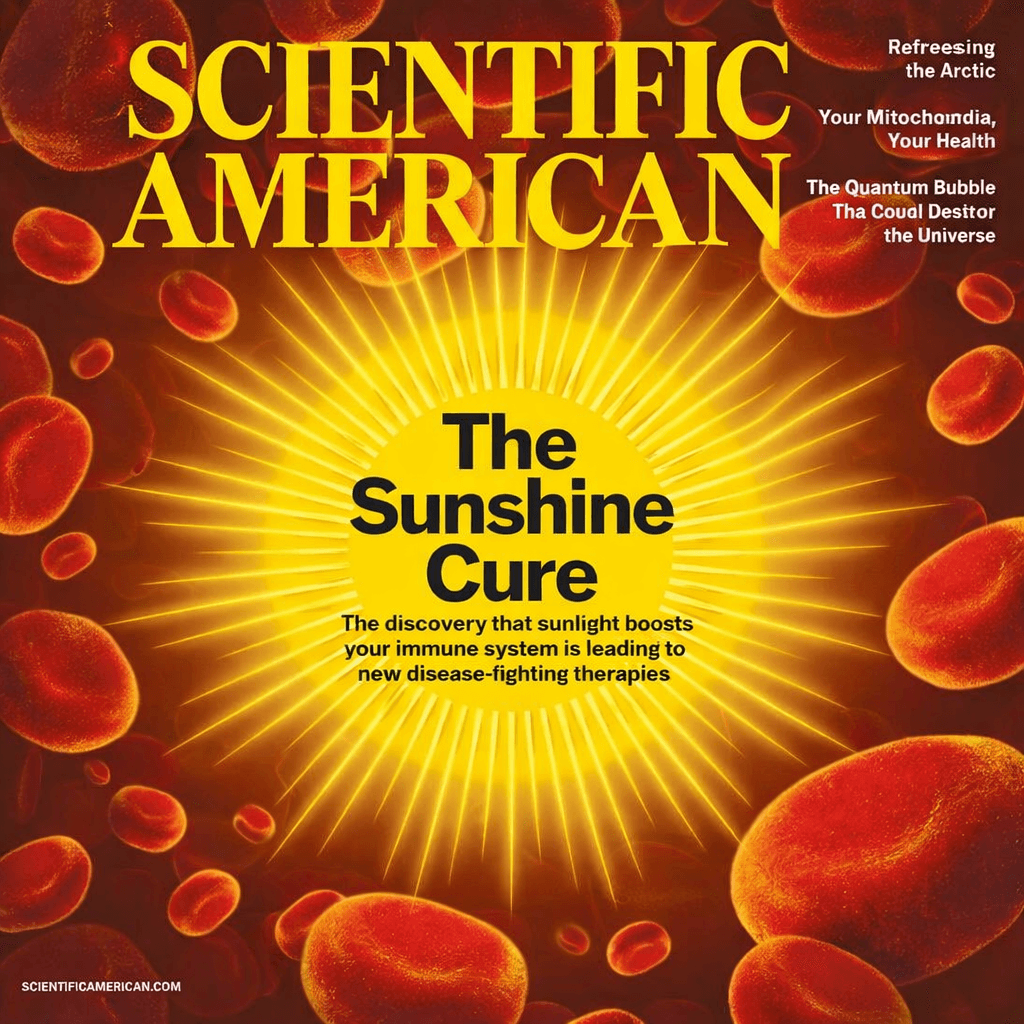
Published June 2025 in Scientific American
Article by Rowan Jacobsen, Edited by Josh Fischman
Article Excerpt
"Every morning Kathy Reagan Young steps out of the shower in her Virginia Beach home, towels off, dons a pair of protective goggles and stands nine inches from a light box the size of a small space heater. Young presses a button, and the box’s bulbs begin to glow a ghostly purple. She briefly bathes her torso in the ultraviolet rays coming from the bulbs, four minutes per side. Then she goes about her day.
That Young can have an ordinary day is remarkable. In 2008 she was diagnosed with multiple sclerosis (MS), a terrible malady in which the body’s own immune system attacks the sheaths that insulate the nerves, destroying them bit by bit. Symptoms begin with weakness, spasms, vision and speech problems, intense fatigue, and what Young calls “cog fog”—chronic low-grade cognitive impairment. Flare-ups can lead to periods of motor-control loss and paralysis. Young, an advocate for MS patients and creator of a popular podcast, has suffered through many such episodes. But things improved with the arrival of her light box.
Ultraviolet (UV) light boxes, which emit only a narrow bandwidth of light that is not linked to skin cancer, have been used for years in the treatment of psoriasis. Young got a prescription from her doctor, and the box was sent to her by a medical-device company called Cytokind that is hoping to expand such use to MS and other autoimmune diseases and was looking for some practical patient feedback. She tried out the device and gave them some pointers: make it smaller and easier to hold because MS often makes your hands go numb, and build in timed reminders to overcome the cog fog. Then, to her surprise, she found that her fatigue disappeared a few months after she started using it.
For years Young had been forced to rest in bed many times a day, but that stopped with what she calls her UV-fueled rebirth. “I was in a meeting, and someone said to me, ‘Wow, you seem like you’re pretty high energy!’” Young says. “And I guess I hadn’t really thought about it. And then two days later my daughter said to me, ‘Mom, what are you on?’ I think we were all a little surprised by how quickly and definitively it happened.” Her MS Disease Activity (MSDA) score, which rates MS severity based on the levels of key inflammatory molecules in the blood, was a 1 out of 10, the best possible score, and it has stayed low for more than a year. MS has no cure, and Young still suffers from transient pain and tingling, but the return of her vitality has made it all more bearable. “It’s incredible,” she says. “My friends used to invite me to things, and I’d say yes, but I always canceled because I was wiped out. Well, not anymore.”"