Featured Research

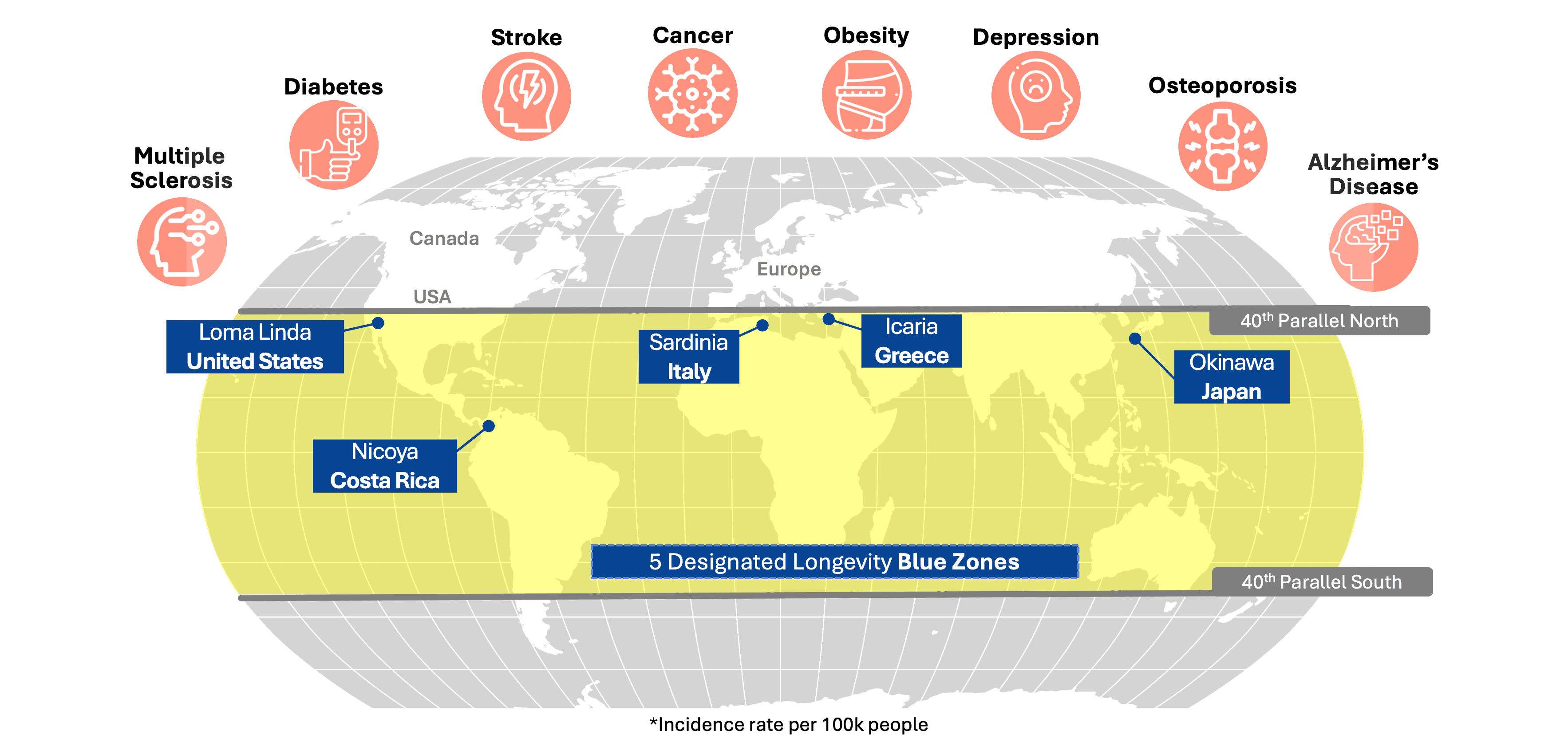
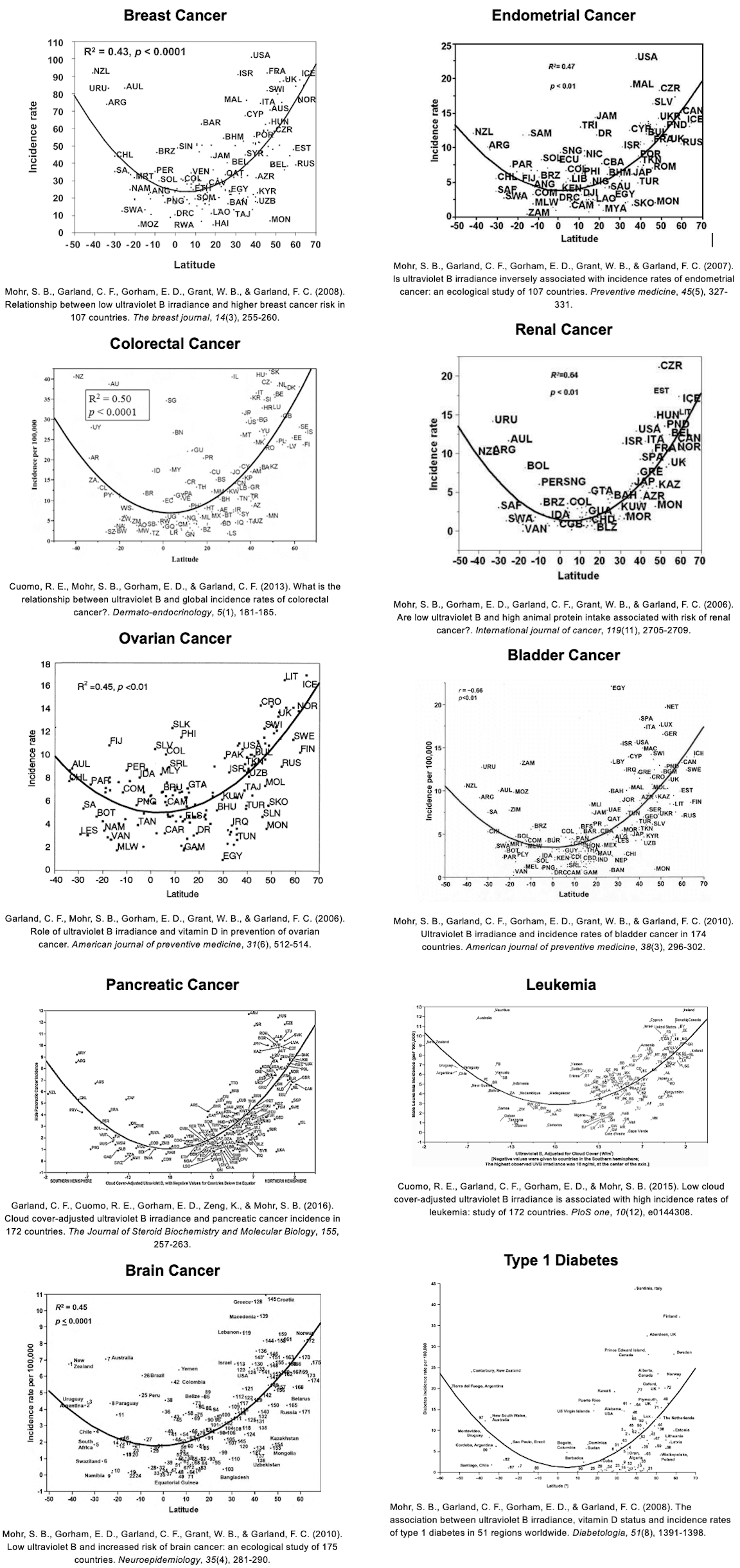
Higher disease rates in low sun latitudes

Multiple Articles


Cancer
Grant, W. B., & Garland, C. F. (2006). The association of solar ultraviolet B (UVB) with reducing risk of cancer: Multifactorial ecologic analysis of geographic variation in age-adjusted cancer mortality rates. Anticancer Research, 26(4A), 2687–2699.

Breast Cancer
Mohr, S. B., Garland, C. F., Gorham, E. D., Grant, W. B., & Garland, F. C. (2008). Relationship between low ultraviolet B irradiance and higher breast cancer risk in 107 countries. The Breast Journal, 14(3), 255–260. https://doi.org/10.1111/j.1524-4741.2008.00576.x

Diabetes
Mohr, S. B., Garland, C. F., Gorham, E. D., & Garland, F. C. (2008). The association between ultraviolet B irradiance, vitamin D status, and incidence rates of type 1 diabetes in 51 regions worldwide. Diabetologia, 51, 1391–1398. https://doi.org/10.1007/s00125-008-1061-5

Multiple Sclerosis
Hedström, A. K., Olsson, T., Kockum, I., Hillert, J., & Alfredsson, L. (2020). Low sun exposure increases multiple sclerosis risk both directly and indirectly. Journal of Neurology, 267, 1045–1052. https://doi.org/10.1007/s00415-019-09695-2

Stroke
Kent, S. T., McClure, L. A., Judd, S. E., Howard, V. J., Crosson, W. L., Al-Hamdan, M. Z., & Kabagambe, E. K. (2013). Short- and long-term sunlight radiation and stroke incidence. Annals of Neurology, 73(1), 32–37. https://doi.org/10.1002/ana.23738

Depression
Wang, J., Wei, Z., Yao, N., Li, C., & Sun, L. (2023). Association between sunlight exposure and mental health: Evidence from a special population without sunlight in work. Risk Management and Healthcare Policy, 16, 1049–1057. https://doi.org/10.2147/RMHP.S401311

Alzheimer’s / Dementia
Ma, L. Z., Ma, Y. H., Ou, Y. N., Chen, S. D., Yang, L., Dong, Q., Cheng, W., Tan, L., & Yu, J. T. (2022). Time spent in outdoor light is associated with the risk of dementia: A prospective cohort study of 362,094 participants. BMC Medicine, 20(1), 132. https://doi.org/10.1186/s12916-022-02317-7

Obesity / Metabolic Health
Muldowney, S., Lucey, A. J., Paschos, G., Martinez, J. A., Bandarra, N., Thorsdottir, I., & Kiely, M. (2011). Relationships between vitamin D status and cardio-metabolic risk factors in young European adults. Annals of Nutrition and Metabolism, 58(2), 85–93. https://doi.org/10.1159/000323999

Osteoporosis
Odén, A., Kanis, J. A., McCloskey, E. V., & Johansson, H. (2014). The effect of latitude on the risk and seasonal variation in hip fracture in Sweden. Journal of Bone and Mineral Research, 29(10), 2217–2223. https://doi.org/10.1002/jbmr.2254

WHO / Sunlight Report
Mead, M. N. (2008). Benefits of sunlight: A bright spot for human health. Environmental Health Perspectives, 116(4), A160–A167. https://doi.org/10.1289/ehp.116-a160

Related Studies

Featured Research

Effectiveness of SOLIUS UVB Light System in Enhancing Serum 25-Hydroxyvitamin D Concentrations: A Randomized Controlled Trial

Anticancer Research

This randomized, placebo-controlled, clinical trial showed that the SOLIUS system effectively increased 25(OH)D concentrations in individuals with vitamin D deficiency or insufficiency, offering a safe solution for improving vitamin D status. The treatment group showed a significant increase in serum 25(OH)D concentrations, with an average increase of 10.2 ng/ml (p<0.01), compared to a decrease of 2.3 ng/ml in the control group.

Featured Research

Effectiveness of SOLIUS UVB Light System in Enhancing Serum 25-Hydroxyvitamin D Concentrations: A Randomized Controlled Trial

Anticancer Research

This randomized, placebo-controlled, clinical trial showed that the SOLIUS system effectively increased 25(OH)D concentrations in individuals with vitamin D deficiency or insufficiency, offering a safe solution for improving vitamin D status. The treatment group showed a significant increase in serum 25(OH)D concentrations, with an average increase of 10.2 ng/ml (p<0.01), compared to a decrease of 2.3 ng/ml in the control group.

Featured Research

Skin Exposure to Narrow Band Ultraviolet (UVB) Light Modulates the Human Intestinal Microbiome

Frontiers in Microbiology

A 2019 clinical pilot study published in Frontiers in Microbiology examined whether skin exposure to narrowband UVB light could influence the human gut microbiome. In healthy adults, three controlled UVB exposures over one week increased serum vitamin D levels and led to measurable changes in gut microbiota composition, particularly in participants who were vitamin D insufficient at baseline. Researchers observed increased microbial diversity and enrichment of bacterial families commonly associated with gut health, supporting the existence of a skin–gut axis through which UVB light exposure may influence intestinal homeostasis. These findings suggest that targeted UVB exposure can have systemic biological effects beyond the skin, potentially linking light exposure, vitamin D status, and microbiome health.

Featured Research

Skin Exposure to Narrow Band Ultraviolet (UVB) Light Modulates the Human Intestinal Microbiome

Frontiers in Microbiology

A 2019 clinical pilot study published in Frontiers in Microbiology examined whether skin exposure to narrowband UVB light could influence the human gut microbiome. In healthy adults, three controlled UVB exposures over one week increased serum vitamin D levels and led to measurable changes in gut microbiota composition, particularly in participants who were vitamin D insufficient at baseline. Researchers observed increased microbial diversity and enrichment of bacterial families commonly associated with gut health, supporting the existence of a skin–gut axis through which UVB light exposure may influence intestinal homeostasis. These findings suggest that targeted UVB exposure can have systemic biological effects beyond the skin, potentially linking light exposure, vitamin D status, and microbiome health.

Featured Research

Pre-Print: Risk–benefit balance of habitual ultraviolet exposure for cardiovascular, cancer, and skin cancer mortality

medRxiv

This large UK Biobank study of 419,007 adults found that higher habitual UV exposure was associated with significantly lower all-cause mortality, cardiovascular mortality, and non-skin cancer mortality, with clear dose-response trends. Critically, higher UV exposure showed no meaningful increase in skin cancer mortality. Counterfactual modeling quantified the trade-off directly: shifting the entire population to high UV exposure would prevent approximately 5,000 deaths from cardiovascular disease and internal cancers at the cost of only a few dozen additional skin cancer deaths - a net survival benefit ratio of roughly 100 to 1. Proteomic analysis in a 44,712-person subcohort identified the biological mechanisms as operating primarily through three non-vitamin D pathways - immunoregulatory, mucosal-barrier, and cardiorenal-neuroendocrine - confirming that the mortality benefits of UV exposure cannot be replicated by oral vitamin D supplementation. The authors conclude that current public health guidance, which frames sunlight primarily as a skin cancer hazard to be avoided, is inconsistent with the weight of evidence and warrants reappraisal. Limitations include the observational design, a White European-only cohort, and preprint status pending peer review.

Featured Research

Pre-Print: Risk–benefit balance of habitual ultraviolet exposure for cardiovascular, cancer, and skin cancer mortality

medRxiv

This large UK Biobank study of 419,007 adults found that higher habitual UV exposure was associated with significantly lower all-cause mortality, cardiovascular mortality, and non-skin cancer mortality, with clear dose-response trends. Critically, higher UV exposure showed no meaningful increase in skin cancer mortality. Counterfactual modeling quantified the trade-off directly: shifting the entire population to high UV exposure would prevent approximately 5,000 deaths from cardiovascular disease and internal cancers at the cost of only a few dozen additional skin cancer deaths - a net survival benefit ratio of roughly 100 to 1. Proteomic analysis in a 44,712-person subcohort identified the biological mechanisms as operating primarily through three non-vitamin D pathways - immunoregulatory, mucosal-barrier, and cardiorenal-neuroendocrine - confirming that the mortality benefits of UV exposure cannot be replicated by oral vitamin D supplementation. The authors conclude that current public health guidance, which frames sunlight primarily as a skin cancer hazard to be avoided, is inconsistent with the weight of evidence and warrants reappraisal. Limitations include the observational design, a White European-only cohort, and preprint status pending peer review.

Get Started

Support

Partner

Be the first to get updates from Solius Labs

By signing up, I agree with the privacy policy.

Connect

Intertek logo

Solius is an FDA cleared over-the-counter (OTC) light panel intended to stimulate production of vitamin D in people 22 years and older.

Solius is clinically proven to stimulate the production of vitamin D. References to the benefits of sunlight, UVB light, and vitamin D are based upon published, peer-reviewed research. The Solius device is not intended to diagnose, treat, cure, or prevent disease, except for the indications for use described in the user manual for your applicable region. Solius does not provide specific medical advice to users. Users should seek advice from a qualified physician or healthcare provider. This website does not establish a doctor-patient relationship. For detailed product information please consult the User Manual prior to use. 

Solius® is a registered trademark of Solius Labs, Inc.
100 Ravine Lane NE, Suite 310, Bainbridge Island, WA 98110

© 2026 Solius Labs, Inc.

Get Started

Support

Partner

Be the first to get updates from Solius Labs

By signing up, I agree with the privacy policy.

Connect

Intertek logo

Solius is an FDA cleared over-the-counter (OTC) light panel intended to stimulate production of vitamin D in people 22 years and older.

Solius is clinically proven to stimulate the production of vitamin D. References to the benefits of sunlight, UVB light, and vitamin D are based upon published, peer-reviewed research. The Solius device is not intended to diagnose, treat, cure, or prevent disease, except for the indications for use described in the user manual for your applicable region. Solius does not provide specific medical advice to users. Users should seek advice from a qualified physician or healthcare provider. This website does not establish a doctor-patient relationship. For detailed product information please consult the User Manual prior to use. 

Solius® is a registered trademark of Solius Labs, Inc.
100 Ravine Lane NE, Suite 310, Bainbridge Island, WA 98110

© 2026 Solius Labs, Inc.

Get Started

Support

Partner

Be the first to get updates from Solius Labs

By signing up, I agree with the privacy policy.

Connect

Intertek logo

Solius is an FDA cleared over-the-counter (OTC) light panel intended to stimulate production of vitamin D in people 22 years and older.

Solius is clinically proven to stimulate the production of vitamin D. References to the benefits of sunlight, UVB light, and vitamin D are based upon published, peer-reviewed research. The Solius device is not intended to diagnose, treat, cure, or prevent disease, except for the indications for use described in the user manual for your applicable region. Solius does not provide specific medical advice to users. Users should seek advice from a qualified physician or healthcare provider. This website does not establish a doctor-patient relationship. For detailed product information please consult the User Manual prior to use. 

Solius® is a registered trademark of Solius Labs, Inc.
100 Ravine Lane NE, Suite 310, Bainbridge Island, WA 98110

© 2026 Solius Labs, Inc.